Contact Star Anise Organic Wholefoods
 

Please use the form on the right to contact me!
I will get back to all enquiries as soon as possible.

Soulla x 


123 Street Avenue, City Town, 99999

(123) 555-6789

email@address.com


You can set your address, phone number, email and site description in the settings tab.
Link to read me page with more information.

Blog

This blog started as a way for me to share my recipes + culinary adventures, tips for vibrant health + happiness, thoughts on the latest developments in nutritional medicine + the low down on the Sydney wholefoods scene and beyond...

Filtering by Category: My Thoughts

Is soy good for us?

Guest User
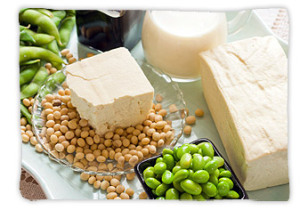
I was recently asked to write a piece about soy products for a publication and thought that I would share my views on soy with my followers on this blog.

The consumption of soy products has grown in popularity in Western societies in recent decades on the notion that soy is a healthy food. After all soy is eaten in numerous countries in Asia without ill effect. And I too jumped on the soy bandwagon in my 20s consuming soy milk instead of cows milk (and scouting out every other soy product under the sun). I still see a lot of clients in my nutritional practice who come to me initially consuming soy milk.

Here’s the thing: traditional Asian societies only ever ate soy beans (which are technically a legume) that were very long fermented (i.e. for numerous days or weeks) eg miso, natto, tempeh, soy sauce or tamari (which is wheat-free soy sauce). This is because soy beans contain extremely high levels of  phytates which wreak havoc on the body including creating nutritional deficiencies, gut permeability (leaky gut) and inhibiting certain digestive enzymes. Traditional societies discovered that only through a process of very long fermentation can the toxic levels of phytates in soy beans be reduced making soy beans more digestible. Small infrequent consumption of these traditionally long fermented soy bean products is ok for the average person who is not suffering from any digestive issues. However, eating large amounts of unfermented soybeans on a regular basis is not a good idea (eg soy milk, soy cheese, soy yogurt, tofu, edamame, soy flour).

Beyond the issue of phytates, soy has additional problems. Soy beans also contain phytoestrogens which adversely affect hormones and can lead to reproductive issues such as infertility.  A study at the Harvard School of Public Health found that consuming just 1 cup per day of soy milk decreased  sperm count, especially in men who were overweight or obese. Other studies found that phytoestrogens in soy may adversely effect male reproductive hormones and sperm capacitation (an important process sperm must go through after being ejeculated into the female reproductive tract). Soy phytoestrogens also have potentially harmful effects on women. A large review of 47 studies found that soy phytoestrogens reduced levels of LH and FSH, 2 hormones essential to fertility and reproductive health, and increased menstrual cycle length (source: Chris Kresser). I don’t think it is coincidental that I see many vegetarian yoga practitioners who eat large amounts of tofu in their diet and are unable to fall pregnant.  Studies show that fermenting soy decreases but does not completely eliminate phytoestrogens.

The research on soy is not however clear-cut. Some studies (like the ones mentioned above) show harm, while others show no harm. On this basis I take a highly precautionary approach. Given that soy is not essential to health, is not nutrient-dense, contains extremely high levels of phytates and that soy phytoestrogens may cause reproductive and endocrine problems, I would recommend avoiding unfermented soy entirely and only consume long-fermented soy products in small infrequent amounts. The table below sets out a quick summary.


A tribute to the most important people in the world: our farmers!

Guest User

Last Saturday I had the pleasure of hanging out with and engaged in riveting conversation with Rob Lennon fromGundooee Organics and Mark Hopkinson from Emerald Hill Beef. These farmers came to Kingsleys Meats butcher for an open day of meet and greet and BBQ sizzle. It was a terrific opportunity to connect with the people who rear our meat and to ask them questions and learn more about the source and provenance of the foods we eat.

Rob Lennon is Australia’s version of America’s Joel Salatin. He has a brain the size of a planet and I always feel humbled in his presence with his wealth of knowledge. Rob farms premium organic wagyu beef in a manner that I would call the high water mark of Australia’s beef farming practices. His farm (Central West NSW, about 5 hours from Sydney) is Australian certified organic and his wagyu beef is supplied to numerous butchers and providores around the country (listed on his website) plus a couple of restaurants (eg Agape Organic Restaurant) .

Here are just some of the things that we talked about that you might be interested in learning:

  • Rob talks a lot about the importance of biodiversity of the microflora in the soil. Understanding and building healthy, balanced soils is the greatest priority on his farm. The nutrients in the soil end up in our bones and body, so everything comes back to the health of the soil.
  • Rob’s cattle graze on predominantly “deep rooted native perennial grasses“. This goes beyond the “grass fed and finished” requirement because a “grass” also includes the cereal grasses that produce grains such as wheat, oats, barley, rye etc. THAT I didn’t know! Cereal grasses are grown in a monoculture environment with little top soil.  The high water mark is “deep rooted native perennial grasses” which have access to different soil types which all contribute to supplying a varietal mix of nutrients to the plants, have better access to moisture, are adapted to our specific climate and are well established in the soil giving them resilience and affording permanent soil cover. So not all “grass fed and finished” meats are the same. Deep rooted native perennial grasses are the best, followed by cereal grasses,with grain-fed cows being at the bottom of list (in terms of nutrition, taste, animal ethics and environmental sustainability).
  • Wagyu (breed of cow) is naturally marbled with fat throughout the muscle meat, even though the cows are fed only grass. For most other breeds of cow, if they are grass fed the fat is encased around the perimeter of the muscle meat and not marbled through it. Grain-fed cows produce a heavily marbled effect which the Japanese in particular covet. However Rob’s wagyu is the best of both worlds because it is grass fed and finishedAND naturally marbled which when cooked provides that melt in your mouth delicious taste experience.
  • Sometimes the best way to remove weeds is to let them run their course as their very existence provides an environment where they will naturally die out without use of chemicals. You can draw analogies here to the human body.
  • Resting meat after is has been cooked is important to allow the muscle fibres (which have tightened and contracted during cooking) to relax providing a better mouth feel. Resting meat also allows the juices to be reabsorbed providing more juicy tender meat.
  • Cooking meat in one whole piece then cutting it into individual steak sized serves provides for better tasting and less inflammatory meat as less surface area of the meat is exposed to a hot surface.

Thank you Rob and Mark and to all of the farmers out there who raise their livestock with compassion on the most healthy pastures and who are committed to providing the best quality meat through a sustainably functioning farm ecosystem.

What can you do?

  • Support the farmers whose beef is raised on deep rooted native perennial grasses or at the very least cereal grasses (as opposed on grain-fed)
  • Find a butcher who has done this due diligence for you who you trust and who has close relationships with the farmers he buys from
  • Before digging into your meal, take a moment to have a think about where the meat has come from and all of the people and things involved to getting your food from soil to plate. I sometimes play this game this with my kids to get them thinking about how connected we all are, the numerous steps in the chain, and to not take our food for granted.

What’s in my medicine cabinet to treat common colds and sore throats

Guest User

I am often asked for recommendations on what natural remedies to take for a common cold or sore throat. Even though Spring is just around the corner (hooray for that!) and the temperatures are rising I often find that it is the change of seasons when many people succumb to colds and sore throats. So here is what I and my kids take when we have a cold or sore throat:

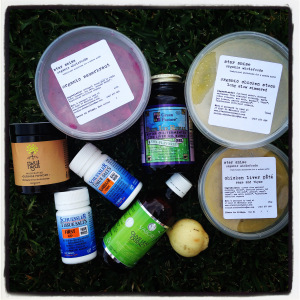
1. Green Pastures fermented cod liver oil. This is high in vitamins A, D and  K2 plus omega 3 fatty acids. 1 tsp/day for adults, 1/2 tsp for children and 2 tsp/day for pregnant/lactating women. I take the cod liver oil infused with the high vitamin butter oil for extra vitamins as I don’t have any dairy intolerances. Otherwise you could take the plain one without butter oil. I sell at $55 or $70 (depending on whether they are capsules or gel and whether they contain butter or not) or purchase directly from GPA Wholefoods.

2. Schuessler homeopathic tissue salts. The 2 I always have on hand are “fer phos” which is akin to a natural Panadol for the onset of cold/fever, and “kali mur” which helps with mucous and sore throats. Take up to 6 each per day. $12ish each for 125 tablets. Sold at organic stores like About Life or The Health Emporium at Bondi.

3. Vabori olive leaf extract. Like everything, source and processing of olive leaf is critically important and after much research this premium quality olive leaf extract is the ONLY brand I would recommend as they use fresh (not reconstituted) olive leaves. Store in fridge and take as directed on bottle.

4. Gargle salt water a few times per day. Make sure your salt is unrefined eg sea salt. A salt water gargle is just as good and safer than any pharmaceutical-based throat gargle.

5. Loving Earth Gubinge Vitamin c powder. Vitamin C great for healing and immunity. 1 tsp / day dissolved in water. Sold at Ovvio Organics at Paddington 5 ways or The Health Emporium at Bondi.

6. In terms of nutrient-dense foods when ill- I advocate lots of home-made gelatinous broth/stock, cultured veggies for natural probiotics, pastured livers, garlic and pastured egg yolks. A tub of my ready-made chicken liver pate is an easy meal when you’re feeling too sick to cook.

7. Drink lots of filtered salted water (add 1/8 tsp per liter of filtered water). Herbal teas like home-made lemon and fresh ginger tea or Ovvio C-Strength tea are great too. Vabori Olive Leaf also now make a herbal tea. and throat lozenges. I have been sipping on their tea all week.

8. Coconut oil – I recommend both oil-pulling to speed up detoxification and adding extra coconut oil in your cooking (eg on steamed veggies or to pan fry) and in smoothies. Coconut oil is anti-microbial, anti-bacteria, anti-fungal and anti-viral… Meaning that it KILLS BAD BUGS! It’s also a natural inflammatory.

9. Immune Defence herbal tonic by Ethical Nutrients. I personally haven’t taken this but it comes highly recommended by integrative GP Dr Min Yeo as an addition to my above list (but not to be taken when pregnant or breastfeeding). Sold in the fridge at Chemist Warehouse (eg Oxford St mall at Bondi Junction). 1-2 per day.

Obviously if your symptoms persist I recommend seeing a holistic practitioner on the same nutritional page such as integrative GP Dr Min Yeo or natropath Anthia Koullouros at Ovvio Paddington 5 Ways. If you live in Melbourne I have a list of like-minded practitioners that I can email you.

Happy healthy healing!