Contact Star Anise Organic Wholefoods
 

Please use the form on the right to contact me!
I will get back to all enquiries as soon as possible.

Soulla x 


123 Street Avenue, City Town, 99999

(123) 555-6789

email@address.com


You can set your address, phone number, email and site description in the settings tab.
Link to read me page with more information.

Blog

This blog started as a way for me to share my recipes + culinary adventures, tips for vibrant health + happiness, thoughts on the latest developments in nutritional medicine + the low down on the Sydney wholefoods scene and beyond...

Filtering by Category: My Thoughts

The active couch potato meets the standing bench. Why exercise isn’t enough.

Guest User
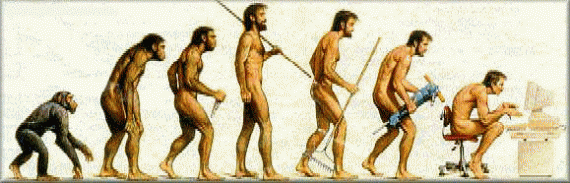
Most people are aware that physical activity is essential to good health and extended sitting is harmful to health. That’s not controversial. It’s how we evolved for the vast majority of our evolutionary history – we had to exert ourselves, often strenuously, on a daily basis. But back then it was called survival and not exercise. Today things are very different. The typical adult in the Western world is sedentary for 60% of their waking hours and sits for an average of 6 hours per day (and often much longer in the case of those who work primarily on computers). In fact, being sedentary is now the norm and exercise is primarily seen as an intervention – something we do to guard against the negative impacts of a sedentary lifestyle.
So here I was thinking that because I engage in moderate to rigorous exercise most days then surely that must counteract any damage done by all the extended sitting I do in front of a computer or being a taxi driver to my kids each day in the car. However multiple studies (eg here and here) show that too much sitting time is still harmful even if you’re getting enough exercise! That’s right, regular vigorous exercise alone isn’t enough to reverse the harmful effects of too much sitting. So if you think your rigorous cross-fit training regimen protects you from the harmful effects of too much sitting when you’re not training – it doesn’t. Damn brother! I realised I am (or was) an “active couch potato”. This phenomenon has become the norm rather than the exception in industrialised countries today.

Ok, so what can we do if we have jobs that involve being in front of a PC  for extended periods of time? How can be get off our butts and standing upright?! Here are some suggestion (summarised from a Chris Kresser article published in the Huffington Post with some obligatory modifications to add in my two cents worth):

1. Work at a  Standing desk

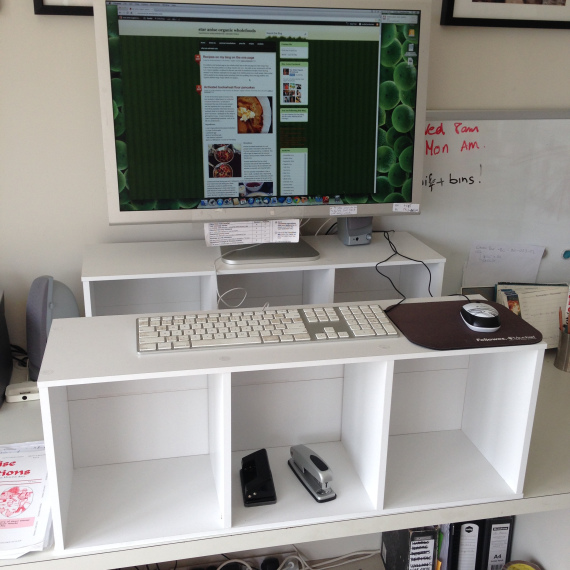
Nowadays you can buy standing desks, portable standing desks and Ikea has designed an inexpensive new height-adjustable standing desk. Or if spending hundreds or thousands of dollars doesn’t appeal to you, you can, like I did, make your own very inexpensive standing desk by buying a couple of 3-tiered shelving units from KMart at a cost of $17 each, then tip them on their side to sit your keyboard, mouse and monitor on them. For the grand total of $34 I have my own standing bench complete with 6 extra storage cavities. Brilliant. These shelving units happen to be the perfect height for me at 5 feet 7 inches (my arms are at a right angle when i type). I stand with my legs at least hip-width apart and am mindful not to lean to one side and to stand upright. This simple change means that i’m now only sitting when driving or eating thereby reducing the hours on my butt by several hours a day.  What if you don’t work from home? I would like to think that most employers nowadays would be open to accommodating a standing bench for their employees. I had a standing desk 17 years ago when I was a lawyer at Freehills so I’d like to think that things have only progressed in the past couple of decades. Back then, of course, I was seen a total aberration in the law firm but the trend caught on and more and more lawyers started to request standing desks.

The transition from sitting to standing at my PC wasn’t too hard for me as I don’t have a regular office job where i’m forced to be at my PC for hours and hours at time. So one question i have been asked a lot recently is how do you transition  from going from sitting at a desk all day to standing all day.  A button-adjustable stand-up desk is wonderful for this reason as it gives you the option of standing or sitting as you please and you can build up a little each day to standing. However, if you have a non-adjustable standing work desk (like I have) and think that going from sitting all day to standing is going to be too big of an initial adjustment, then sit down at another desk if available wherever you can for non-computer tasks so that you are doing a combo of  standing (for PC work) and sitting (eg when talking on the mobile, reading, etc).

2. Take it to the next level with a treadmill desk (this is what health guru Chris Kresser in the USA does).

3. Walk or bike to work (or part of the way) eg get off the train 1 or 2 stops earlier then walk rest of the way.

4. Do whatever mundane household tasks you can standing like opening mail, talking on the phone, reading letters, folding clothes etc. Whenever you are sitting simply ask yourself “must I be sitting right now or could I do this standing?”

5. Take regular standing breaks during extended sitting periods

6. Organise walking or standing meetings. More and more executives are doing this.

7. Sit more actively if you can’t stand or walk eg sit on a fit ball or learn to sit up straight this will engage your back muscles more actively than simply being dead weight in a chair. When driving in the car, you should know that bucket seats are hideous for the lower back. They tighten the hip flexors which in turn strains the lower back.  My tip here is the get one or more rolled up towels and place them right in the nook of the seat to effectively level out the seat so that your hips are higher than (or at least the same height as) your knees. It might feel like your driving a bus with your head almost scraping the roof of the car but, hey, it sure beats chronic lower back pain. I miraculously “cured” my incessant gnawing lower back pain within 24 hours by doing this.

As an aside, if you’re spending more and more time standing and /or walking please have a think about what you are wearing on your feet. Thongs and high heels are the worst things you can wear on your feet as movement coach and PT Chris Ogle reminds us regularly in his fascia release classes at Centennial Health Club. Thongs make you claw the ground and put tremendous strain on the feet,  tightening the feet muscles and changing your gait. It’s a pet hate of mine seeing young kids wear thongs. Birkenstocks are NOT thongs even though they don’t have a strap around the ankle because they come up quite high on the top of the foot which makes it unnecessary to claw at the ground. Birkies are great but recently I bought these summer sandals (pictured) from Camper- comfy and fun to wear with extra spring in my step.  High heels shorten calf muscles which have a detrimental cascading effect on the rest of the body. Occasional wear is unavoidable for most women but wearing them every day can be pretty gruelling on the body (I know as I did it for 10 years as a lawyer in my former life).

 Do you use a standing desk? Where did you get it from and how do you find it? I’d be very interested to hear what people are doing for school-aged kids re standing desks. Please share.

What is resistant starch and why you should consume it

Guest User

Resistant starch is all the rage right now in the ancestral health community. I have been receiving numerous enquiries over the past few months about resistant starch and how to consume it. Firstly I want to point out that I don’t follow trends. I try to understand the science behind something before I alter any of my lifestyle choices. So let’s start with the science and a potted summary of gut health because this is where it all begins….

  • Our health depends on the health of our gut (by “gut” I’m referring to the Gastro-Intestinal tract that runs from the mouth to the anus).
  • The health of our gut in turn depends on the balance, number, location and strains of bacteria that live there (this bacterial film is often referred to as our microbiota, microbiome, or gut flora).
  • The bacteria that live in our gut span the spectrum of good or friendly bacteria (called probiotics or ‘old friends’) on the one hand and bad bacteria (pathogens) at the other end of the spectrum with a heap in between.
  • The good guys should outnumber the bad guys by 85% to 15%. The location of that bacteria is really important: they should mostly be in the colon, the large intestine.
  • When the balance or location or the different strains of bacteria is out of whack, our health is compromised, either in some minor way (eg reduced immunity leading to colds and infections. NB 75% to 80% of the immune cells in the body are in the gut, so changes to your gut microbiome are absolutely going to affect your immunity and your ability to fight off infections) or acutely (eg SIBO, leaky gut, brain and/or skin disorders, autoimmunity).
  • There are a number of factors that affect our intestinal bacteria, diet being one of them (others include antibiotics, the sterility of our environment, C-section versus vaginal birth, the contraceptive pill, acid-stopping drugs, smoking, the use of colonics, environmental toxins, pesticides, heavy metals).
  • Anthropological evidence shows that many strains of good bacteria that appeared in our hunter-gatherer ancestors have permanently disappeared from the modern gut today. We pass on our microbiome down to our children through birth from generation to generation so the state of our health and our lifestyle choices today will affect the health of future generations. As Chris Kresser recently put it “if we change or eliminate certain species of gut flora that have been living in our guts for millions of years or hundreds of thousands of generations and we wipe them out, we’ve permanently changed essentially what it means to be human because we have 10 times more bacterial cells than we do human cells, so it’s a big deal.”
  • I wont go into all the details on what the good bacteria do for our health but without them we can’t survive and we need them for strong immunity, healthy digestion, good brain function, healthy skin, calm nervous system, and a well-functioning metabolism.

A diet rich in lacto-fermented foods provides natural probiotics (good bacteria) that populate our gut. But once the good bacteria are there these essential little critters need to be kept alive and kicking. Enter prebiotics. Prebiotics are the food for the probiotics already in our gut to keep them alive and healthy. So we need a diet rich in both probiotics (to populate our gut with new strains of good bacteria) and prebiotics (as their fuel source). Fortunately a nutrient-dense traditional wholefoods diet can provide, for most people, a good source of both without resorting to over the counter supplements. I always try to obtain my nutrients from wholefood sources wherever possible. Prebiotics are generally classified into three different types: non-starch polysaccharides, soluble fiber, and resistant starch (RS).  Each of these types of prebiotics feeds different species of gut bacteria, but of these, RS is most recently donning the spotlight for its ability to lower blood glucose levels, improve insulin sensitivity (which contributes to fat loss), act as a powerful anti-inflammatory agent and maintain the integrity of our gut by decreasing intestinal permeability. RS is a type of starch that is not digested in the stomach or small intestine, reaching the colon (the large intestine) intact.  Thereby “resisting” digestion.  This explains why RS does not result in spikes in either blood glucose or insulin, and why we do not obtain significant calories from RS.  Once RS reaches the large intestine, bacteria attach to and digest, or ferment, the starch.  This is when we receive the benefits of RS.

Examples of RS include:  

(a)  starch found in grains, seeds, and legumes;
(b) starch found in raw potatoes, green (unripe) bananas, and raw plantains.  Cooking these foods causes changes in the starch making it digestible to us, and thus removing the RS;
(c) retrograde RS since this type of RS forms after RS found in foods listed in (a) or (b) above are cooked and then cooled for 24 hours.  Examples include cooked and cooled parboiled rice, cooked and cooled potatoes, and cooked and cooled properly prepared (soaked or sprouted) legumes.

Since many of my clients and people who follow a nutrient-dense traditional wholefoods diet do not eat much if any grains, seeds and legumes, and since raw potatoes and green unripe bananas are not so tasty and since plantains are rare as hens teeth in Australia well that just leavescooked and cooled potatoes as our most practical wholefood source of RS. To that end I have put together the following 2 simple recipes incorporating cooked and cooled potatoes that I am now incorporating into my and my kids’ diet:

In the coming weeks I will also post recipes for avocado and raw salmon nori rolls and Greek rice pudding (both incorporating cooked and cooled white rice- properly soaked then rinsed before being cooked then cooled).

Kids typically love all of the above dishes so adding them into your culinary repertoire shouldn’t be a hardship. They are a convenient lunch box idea (obviously make them the day before) as well as fun summer time food perfect for picnics and easy dinners when you don’t feel like eating hot food. At it’s most simplest level you could get into the habit of adding some chopped potatoes to your evening steamed veggies then pop all or some of them in the fridge to be consumed the following day in kids’ school lunch boxes and into your salad for lunch. Just a thought.

How often do I eat cooked and cooled potatoes? At least once  if not twice a week. A little less often in the case of cooked and cooled white rice.  So I guess this has been a change for me, in a practical sense, since reading about RS. I’m not sure how important the 24 hours of cooling is prior to consuming the cooked and cooled potatoes. In my household sometimes these dishes get consumed in less than 24 hours of being cooked but if you can be a little organised and prepare ahead of time then all the more power (and prebiotics) to you!

To read a more comprehensive article on prebiotics and RS written by Chris Kresser click here  (I have essentially condensed and summarised the punch lines for you in this blog post). In his article Chris points out that if you are on a low carbohydrate diet or don’t tolerate potatoes well you can add RS to your diet via unmodified Potato Starch (NOT potato flour), plantain flour and/or green banana flour (by adding to cold or room temperature water, almond milk, or mixed into smoothies). His article comes with the usual caveat that if you suffer gastro-intestinal tract distress with even small amounts of RS, this may be an indication of SIBO (small intestinal bacterial overgrowth) or microbial dysbiosis, and you may need to consider working with a healthcare practitioner to establish a more balanced gut microbiome through the use of herbal antimicrobials and probiotics before adding RS or other prebiotics. To that end for those of you living in Sydney I highly recommend working with a holistic practitioner on the same nutritional page such as integrative GP Dr Min Yeo or natropath/herbalist Anthia Koullouros (both at  Ovvio Paddington 5 Ways). If you live in Melbourne I have a list of like-minded practitioners that I can email you

so how was school today?

Guest User

I recently read this article from my son’s school newsletter and thought I would share it. It is written by the Assistant Head of Junior Preparatory Years 2 – 4 of The Scots College and the idea behind it is to ask more specific questions about your child’s school day rather than simply, “How was school today?” which often results in a response of “good” and not much more.  

25 Ways to Ask Your Kids “So How Was School Today?”

1. What was the best thing that happened at school today? (What was the worst thing that happened at school today?) [I often play this game of highs and lows with my kids: What was your high today? What was your low?]

2. Tell me something that made you laugh today.

3. If you could choose, who would you like to sit by in class? (Who would you NOT want to sit by in class? Why?)

4. Where is the coolest place at the school?

5. Tell me a weird word that you heard today. (Or something weird that someone said.)

6. If I called your teacher tonight, what would she tell me about you?

7. How did you help somebody today?

8. How did somebody help you today?

9. Tell me one thing that you learned today.

10. When were you the happiest today?

11. When were you bored today?

12. If an alien spaceship came to your class and beamed someone up, who would you want them to take?

13. Who would you like to play with at recess that you’ve never played with before?

14. Tell me something good that happened today.

15. What word did your teacher say most today?

16. What do you think you should do/learn more of at school?

17. What do you think you should do/learn less of at school?

18. Who in your class do you think you could be nicer to?

19. Where do you play the most at recess?

20. Who is the funniest person in your class? Why is he/she so funny?

21. What was your favourite part of lunch?

22. If you got to be the teacher tomorrow, what would you do?

23. Is there anyone in your class who needs a time-out?

24. If you could switch seats with anyone in the class, who would you trade with? Why?

25. Tell me about three different times you used your pencil today at school.

You can see how these may be useful in opening up more meaningful dialogue between yourself and your child. I’m going to give them a try to curb groundhog dog questions and answers. Hey, with a bit of modification, what not try some out on your partner?!? Could provide for some humorous or creative responses…